Prevention and ophthalmic monitoring
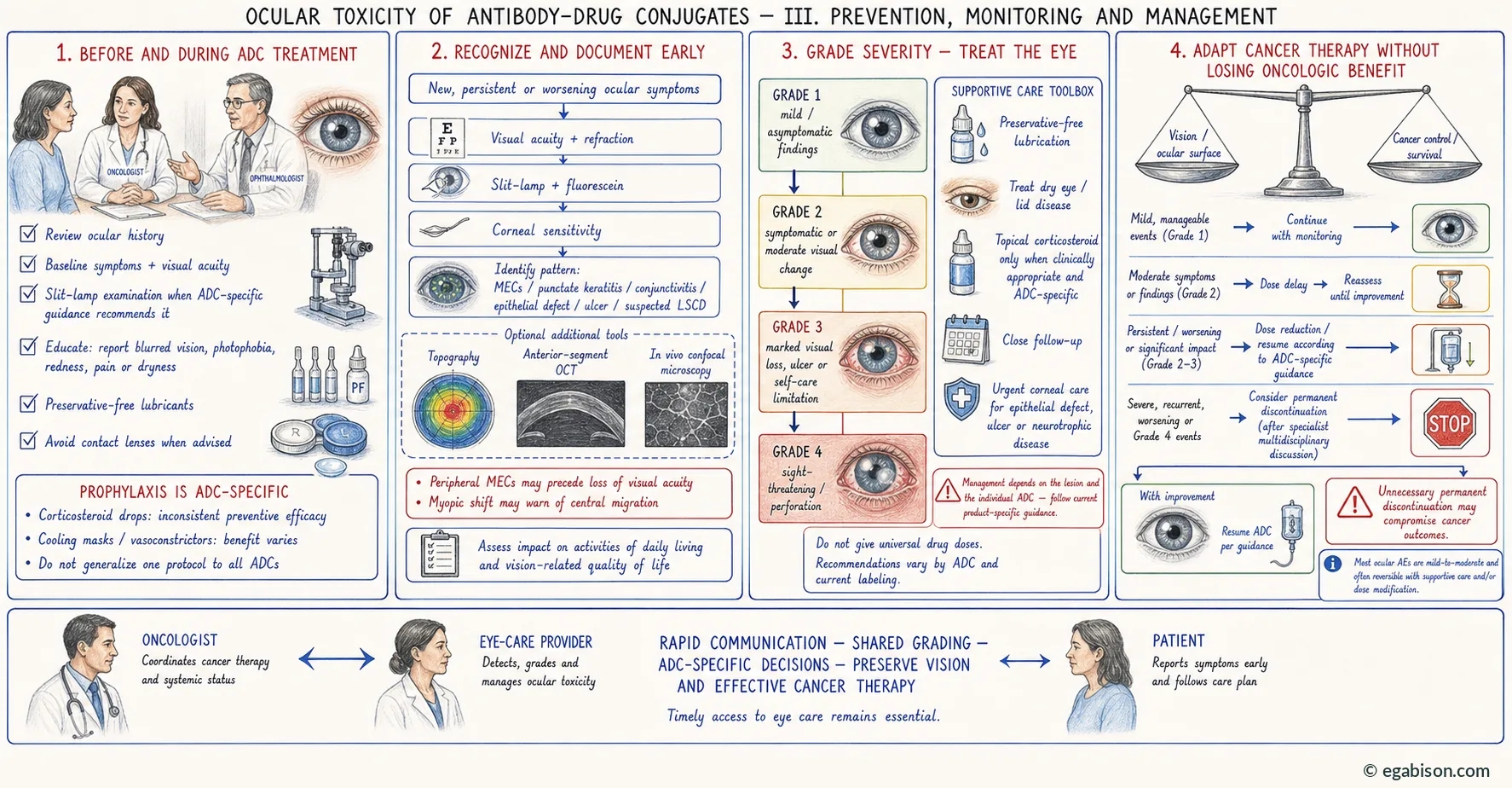
Several prophylactic measures that generally mitigate ADC-related ocular adverse events have been proposed. None is the subject of consensus, and available data are contradictory across agents.
10.1. Topical lubricants
Regular use of prophylactic lubricating eye drops — preservative-free artificial tears — before and during treatment with belantamab mafodotin or enfortumab vedotin is recommended, as well as avoidance of contact lenses. The choice of preservative-free formulations is not trivial in a population whose corneal epithelium is already injured and whose renewal is slowed.
10.2. Topical corticosteroids
Data from phase 1 and 2 clinical studies have shown contradictory results with regard to the effectiveness of prophylactic ophthalmic corticosteroid eye drops in preventing corneal epithelial changes with tusamitamab ravtansine, belantamab mafodotin, tisotumab vedotin or mirvetuximab soravtansine.
Favourable results. Prophylactic measures including the use of topical corticosteroid eye drops for the first three days of treatment reduced the incidence of conjunctivitis in the phase 1–2 InnovaTV 20117 study of tisotumab vedotin in patients with advanced or metastatic solid tumours. The use of corticosteroid eye drops as prophylaxis for conjunctival disorders is recommended as part of the eye care plan for patients receiving tisotumab vedotin, with administration prior to and for 72 hours after infusion. Similarly, primary prophylaxis with corticosteroid eye drops showed a trend towards a lower incidence of keratopathy compared with no prophylaxis in a phase 1 trial of mirvetuximab soravtansine in patients with relapsed ovarian cancer. Mirvetuximab soravtansine was approved by the European Commission on 18 November 2024; the US prescribing information for this ADC recommends prophylaxis with ophthalmic topical corticosteroids.
Unfavourable results. In contrast, the application of primary prophylaxis — including with an ocular corticosteroid gel — during treatment with tusamitamab ravtansine did not alleviate ocular toxicity in a phase 1 dose-escalation study in patients with advanced solid tumours, and the maximum tolerated dose was determined to be 100 mg/m². Prophylactic corticosteroid eye drops were also ineffective in preventing keratopathy in the phase 2 DREAMM-2 study of belantamab mafodotin, with a similar incidence of grade 3 keratopathy in treated versus untreated eyes, and a similar median time to keratopathy between eyes.
This inconsistency between studies clearly suggests that ocular adverse events of ADCs likely differ according to the target of the monoclonal antibody, the nature of the linker and the mode of action of the payload. It forbids transposing a prophylactic protocol validated for one agent to the class as a whole. The DREAMM-2 protocol in particular offers a within-patient control — treated eye versus untreated eye — whose negative result is difficult to circumvent for belantamab mafodotin.
10.3. Reducing blood flow: cold and vasoconstrictors
The US prescribing information for tisotumab vedotin recommends the use of topical ocular vasoconstrictor drops immediately prior to each infusion and cooling eye pads during the infusion to reduce the risk of ocular adverse events. These preventative measures were associated with a reduced frequency and severity of ocular adverse events, including conjunctivitis, in the phase 1–2 trial of tisotumab vedotin.
However, these preventative measures were of limited effectiveness for preventing corneal adverse events, including keratopathy, in a phase 1 trial of tusamitamab ravtansine in patients with advanced solid tumours. Cooling eye masks were also used prior to belantamab mafodotin infusions in DREAMM-2, but similarly, the efficacy of this approach is uncertain and it should be used with discretion.
Data from a phase 1/2 study of praluzatamab25 ravtansine in patients with advanced solid tumours suggested that ocular prophylaxis — vasoconstrictors, corticosteroids, artificial tears — had some effectiveness in preventing ocular adverse events, given that more ocular events were reported in patients who did not versus patients who did receive prophylactic medications.
Monitoring symptomatic patients
Patients with ocular symptoms that do not resolve or worsen should be followed with regular ocular examinations — visual acuity and slit lamp — carried out by an ophthalmologist throughout treatment, as recommended for belantamab mafodotin, enfortumab vedotin, mirvetuximab soravtansine and tisotumab vedotin.
The optimal schedule for ocular examination likely differs among various ADCs and should take into consideration the balance between the potential severity of the ocular adverse event versus the underlying cancer, and also the loss in quality of life for the patient when repetitive examinations are needed before each infusion of ADC.
This last consideration is too often overlooked. A patient undergoing treatment for advanced cancer, subjected to a full ophthalmic examination before every cycle, bears a burden of appointments and travel that is not negligible. Monitoring frequency should be proportionate to the risk profile of the agent and to the individual history, not applied uniformly.
Minimum recommended work-up in the symptomatic patient
- Best-corrected visual acuity and refraction — refraction documents the hyperopic or myopic shift and indirectly localises the lesion.
- Slit-lamp examination with fluorescein — identification of the pattern: MECs, punctate keratitis, conjunctivitis, epithelial defect, ulcer, suspected LSCD.
- Corneal sensitivity — screening for neurotoxicity, which conditions the risk of neurotrophic keratopathy.
- Impact on activities of daily living — a constitutive element of CTCAE grading.
Optional additional tools — corneal topography, anterior-segment OCT, in vivo confocal microscopy — provide useful objective documentation when an oncologic decision is at stake, but are not indispensable to routine practice.