
Epidemiology by molecule and CTCAE grading
Reported incidences vary considerably by agent, dose, population and — decisively — by whether the study included systematic ophthalmic examination. The table below summarises the main data reported for approved and investigational ADCs.
| ADC | Target / payload | Indication (n) | Reported ocular toxicities |
|---|---|---|---|
| Approved ADCs | |||
| Belantamab mafodotin (withdrawn in the US) | BCMA / MMAF | Relapsed or refractory multiple myeloma (n=95) | Keratopathy 71 % all grades, 27 % grade 3; blurred vision 22 % / 4 % grade 3; dry eye 14 % / 1 % grade 3 |
| Enfortumab vedotin | Nectin-4 / MMAE | Advanced urothelial carcinoma (n=296) | Corneal disorders 1 %; dry eye 16 % / 1 % grade 3; blurred vision 4 % |
| Mirvetuximab soravtansine | FRα / ravtansine | Platinum-resistant ovarian cancer (n=106) | Keratopathy 36 % all grades, 9 % grade ≥3; blurred vision 41 % / 6 % grade ≥3 |
| Tisotumab vedotin | Tissue factor / MMAE | Recurrent or metastatic cervical cancer (n=102) | Keratitis 11 % (grades 1–2); ulcerative keratitis 2 % (grade 3); dry eye 23 %; conjunctivitis 26 % |
| Trastuzumab deruxtecan | HER2 / deruxtecan | HER2+ breast cancer (n=184) | Dry eye 12 % all grades |
| Trastuzumab emtansine | HER2 / mertansine | HER2+ metastatic breast cancer (n=884) | Blurred vision 5 %; dry eye 4 %; conjunctivitis 4 %; increased lacrimation 3 % |
| HER+ advanced mBC (n=28) | Eye disorders 14 %; cataract, ocular surface disease and punctate keratitis of grade 3 in 2 patients | ||
| Investigational ADCs | |||
| Anetumab ravtansine | Mesothelin / ravtansine | Pleural mesothelioma (n=163) | Corneal disorder 40 % all grades, 2 % grade 3; dry eye 13 % |
| Platinum-resistant ovarian cancer + liposomal doxorubicin (n=9) | Corneal epithelial changes 48 % (grades 1–2); corneal disorder 29 %; dry eye 17 %; blurred vision 14 % | ||
| ARX788 | HER2 / AS269 | HER2+ metastatic breast cancer (n=69) | Corneal epitheliopathy 46 % all grades, 4 % grade ≥3; blurred vision 22 %; xerophthalmia 22 % |
| Coltuximab ravtansine | CD19 / ravtansine | Diffuse large B-cell lymphoma (n=52) | Eye disorders 19 %; corneal events 6 %; extracorneal events 12 % |
| Datopotamab deruxtecan | TROP2 / deruxtecan | Triple-negative breast cancer (n=43) | Dry eye, retinal exudates, blurred vision requiring dose reduction (incidences not reported) |
| Praluzatamab ravtansine | CD166 / ravtansine | Advanced solid tumours (n=99) | Keratitis 21 % all grades, 9 % grade ≥3; blurred vision 16 %; dry eye 8 %; photophobia 3 % |
| Trastuzumab duocarmazine | HER2 / duocarmycin | Metastatic solid tumours and HER2+ BC (n=146) | Keratitis 17 % (grades 1–2), 2 % grade 3; dry eye 30 %; conjunctivitis 28 %; increased lacrimation 20 %; retinal haemorrhage 1 % |
| Tusamitamab ravtansine | CEACAM5 / ravtansine | Advanced solid tumours (n=31) | Keratopathy 26 % (grades 1–3), 19 % grade 3; keratitis 3 %; dry eye 13 % |
| CEACAM5+ NSCLC treated ≥12 months (n=11) | Keratitis/keratopathy 73 % all grades, 36 % grade ≥3 | ||
Table. Ocular adverse events reported with approved and investigational ADCs. Data extracted from Prog Retin Eye Res 2024;103:101302 (Table 2). Incidences are not directly comparable across studies: the depth of ophthalmic assessment and the definitions used differ between protocols.
Three observations structure the interpretation. First, the highest incidences involve ADCs carrying MMAF or a DM4/ravtansine maytansinoid — consistent with the pharmacological data. Second, incidence rises with duration of exposure, as illustrated by the 73 % keratitis/keratopathy rate in patients treated for at least twelve months with tusamitamab ravtansine. Third, the proportion of grade ≥3 events varies markedly at comparable overall incidence, suggesting that severity depends at least as much on surveillance and timeliness of intervention as on the agent itself.
No other molecule illustrates the stakes of this chapter as well. The regulatory path of belantamab mafodotin was decided by its corneal toxicity.
On 5 August 2020, the FDA granted accelerated approval to belantamab mafodotin as monotherapy for relapsed or refractory multiple myeloma after at least four prior lines, based on DREAMM-213. Approval came with a risk-management programme built around ophthalmic monitoring. In DREAMM-2, keratopathy affected 71% of patients, 27% at grade 3. Prophylactic corticosteroid drops were tested there under intra-individual control — one eye treated, the other not. They failed.
In November 2022, the confirmatory DREAMM-341 trial missed its primary progression-free survival endpoint. The FDA requested withdrawal; the licence was formally revoked on 20 March 2023.
Combination trials resumed the demonstration. DREAMM-742 combined belantamab with bortezomib and dexamethasone, DREAMM-843 with pomalidomide and dexamethasone. DREAMM-7 was positive for both progression-free and overall survival, with a 51% reduction in the risk of death against a daratumumab-based triplet.
Yet on 17 July 2025, the FDA's Oncologic Drugs Advisory Committee46 voted against the benefit–risk profile of both combinations: five to three against the bortezomib combination, seven to one against the pomalidomide combination, and seven to one against the proposed dosing schedule. The FDA briefing document stated the reason plainly: ocular toxicity — keratopathy, visual acuity changes, blurred vision and dry eye — with high rates of grade 3–4 events leading to prolonged and recurrent treatment interruptions.
On 23 October 202547, after an extended review, the FDA approved the bortezomib and dexamethasone combination from the second line onward, with a boxed warning for ocular toxicity. The European Commission approved the DREAMM-7 and DREAMM-8 combinations. In DREAMM-7, 92% of patients experienced ocular toxicity, 77% at grade 3 or 4, and 83% required dose modification.
The lesson. A drug whose phase 3 trial demonstrated an overall survival benefit came close to being refused approval because of its corneal profile. Here, ophthalmic expertise does not accompany cancer treatment — it governs access to it.
- Tusamitamab ravtansine — Sanofi ended the entire development programme on 21 December 2023, after the phase 3 CARMEN-LC0348 trial missed its primary progression-free survival endpoint. The 73% keratitis or keratopathy rate observed in patients exposed for at least twelve months retains its demonstrative value regarding exposure duration, but relates to a molecule no longer in development.
- Mirvetuximab soravtansine — approved by the European Commission on 18 November 2024 for FRα-positive, platinum-resistant high-grade serous epithelial ovarian, fallopian tube or primary peritoneal cancer after one to three prior lines. The first FRα-directed ADC authorised in the Union.
- Datopotamab deruxtecan — approved by the FDA on 17 January 2025 for advanced HR+/HER2− breast cancer, then on 22 May 2026 for triple-negative breast cancer not eligible for a PD-1/PD-L1 inhibitor. The hurricane keratopathy of Figure 4 therefore no longer concerns an investigational molecule but a marketed treatment.
- Belantamab mafodotin — see the box above.
CTCAE grading
Grading of ocular adverse events according to the National Cancer Institute Common Terminology Criteria for Adverse Events constitutes the shared language between oncologist and ophthalmologist. It combines symptomatic criteria, best-corrected visual acuity and impact on activities of daily living.
One methodological point deserves emphasis: there is no single "ocular toxicity" scale. Each event — conjunctivitis, dry eye, keratitis, other eye disorders — has its own ladder. Grading a patient therefore requires first identifying the lesion, and only then scoring it.
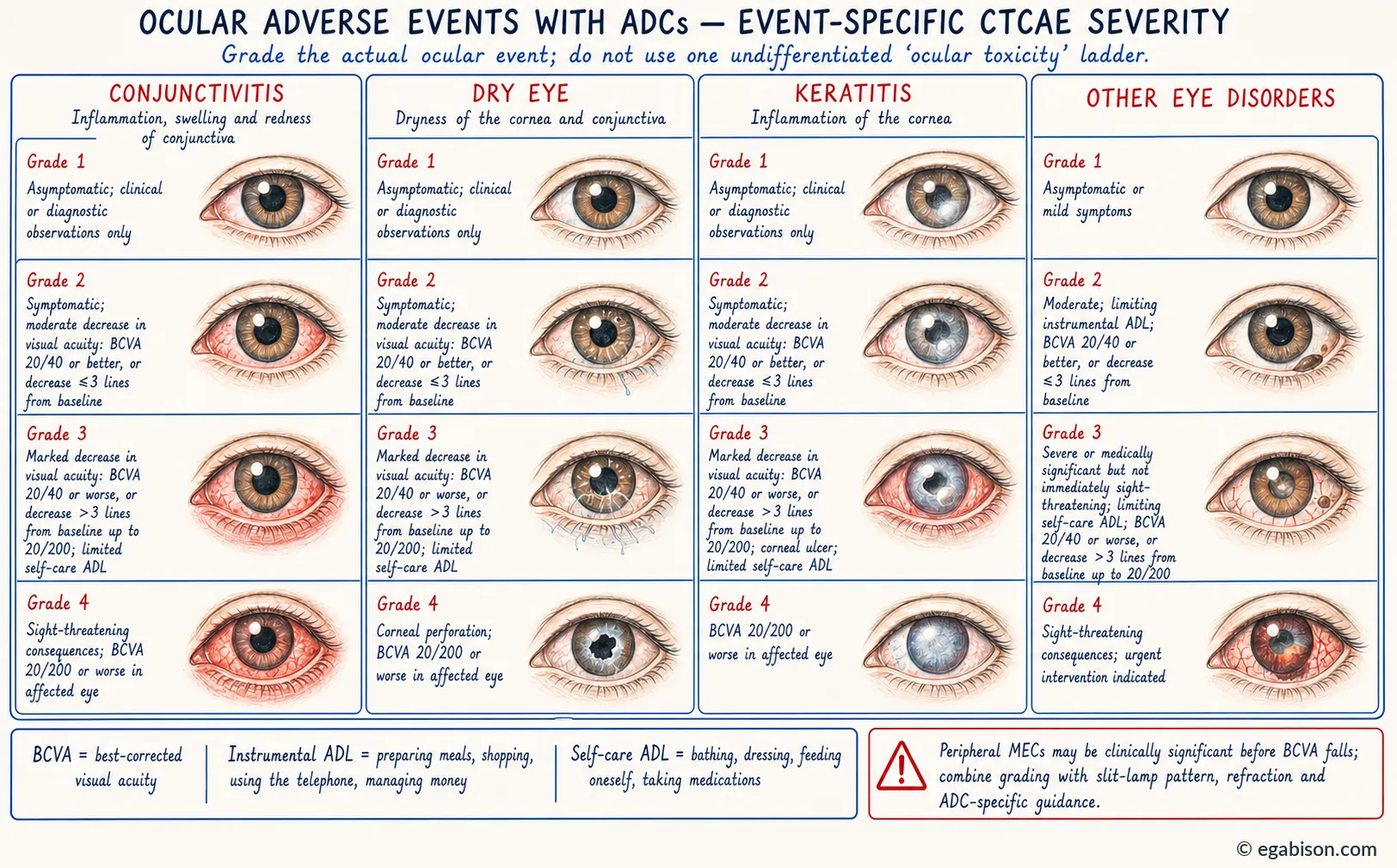
In practice, best-corrected visual acuity may not be a reliable measure in the early stages of keratopathy, because microcysts start at the periphery of the eye without impacting visual acuity. A patient may therefore have extensive keratopathy with normal acuity and be scored grade 1. Conversely, reduced vision — mostly a myopic shift — should be considered a warning about potential migration or accumulation of MECs from the peripheral to the central cornea. Slit-lamp examination and refraction therefore precede grading; they do not follow it.
The figure above reproduces an error that must not be carried into practice. In CTCAE v5.0, dry eye has no grade 4: the scale stops at grade 3. And perforation belongs to grade 4 keratitis, whose official definition is "perforation; best corrected visual acuity of 20/200 or worse in the affected eye". Perforation therefore belongs in the keratitis column, not the dry eye column.