
ADC-specific management and dose modification
Descriptions of the key ocular adverse events according to CTCAE grade have been provided above. Most of the ocular adverse events seen with ADCs are mild and reversible — grade 1–2 — and can be managed with dose modifications or delayed infusion and supportive care.
However, involvement of eye care professionals, including ophthalmologists, optometrists or other eye care specialists, may be necessary in certain cases, such as when ocular adverse events develop and do not resolve or worsen. Some ocular adverse events may necessitate the reduction, discontinuation or even interruption of anticancer treatment, after close collaboration between the ophthalmologist and the patient's oncologist, but most others may be managed with topical ocular treatments without discontinuation of cancer treatment.
Although there are no consensus guidelines for the mitigation and management of ADC-related ocular adverse events, recommendations have been made, either in product labelling information or by study investigators, for several individual ADCs known to be associated with ocular adverse events. It is important to note that mitigation and management recommendations vary based on the clinical evidence of the individual ADC and should not be generalised across ADCs.
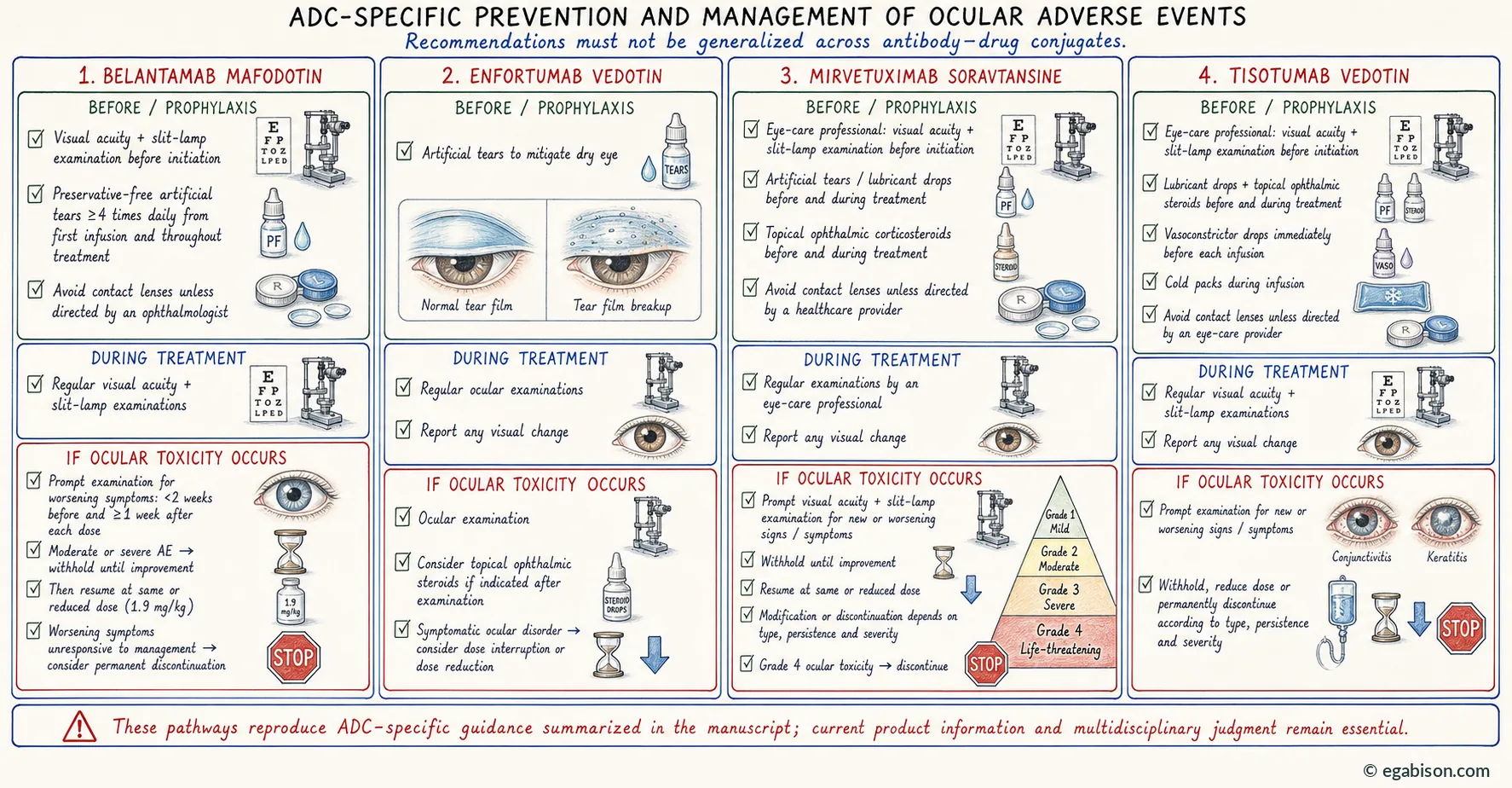
| ADC | Prophylactic measures | During treatment | Should ocular toxicity occur |
|---|---|---|---|
| Belantamab mafodotin withdrawn in the US |
Ocular examination (visual acuity and slit lamp) prior to initiation; preservative-free artificial tears ≥4 times daily from the first day of infusion and during treatment; avoid contact lenses unless directed by an ophthalmologist | Regular ocular examinations (visual acuity and slit lamp) | Prompt examination for worsening symptoms: <2 weeks prior to and ≥1 week after each dose. Moderate or severe AE → withhold until improvement, then resume at same or reduced dose (1.9 mg/kg). Worsening symptoms unresponsive to management → consider permanent discontinuation |
| Enfortumab vedotin | Administer artificial tears to mitigate dry eye | Regular ocular examinations; advise patients to contact their healthcare provider if they experience any visual changes | Ocular examination; consider ophthalmic topical steroids if indicated after an ocular examination; consider dose interruption or dose reduction for symptomatic disorders |
| Mirvetuximab soravtansine | Ocular examination by an eye care professional prior to initiation; artificial tears/lubricant eye drops before and during treatment; ophthalmic topical steroids before and during treatment; avoid contact lenses unless directed by a healthcare provider | Regular examinations by an eye care professional; advise patients to report any visual changes | Prompt examination for new or worsening signs and symptoms; withhold until improvement and resume at same or reduced dose; modification or discontinuation depends on type, persistence and severity; discontinue for grade 4 ocular toxicity |
| Tisotumab vedotin | Ocular examination by an eye care professional prior to initiation; lubricant eye drops and ophthalmic topical steroids before and during treatment; vasoconstrictor eye drops immediately before each infusion; cold packs; avoid contact lenses unless directed by an eye care provider | Regular ocular examinations; advise patients to report any visual changes | Prompt examination for new or worsening signs and symptoms; withhold, reduce dose or permanently discontinue based on type, persistence and severity of the ocular AE |
Table. Recommended strategies for minimising and mitigating ocular adverse events for specific ADCs. After Table 3 of Prog Retin Eye Res 2024;103:101302.
12.1. Available ophthalmic treatments
Some ADC-related ocular adverse events may be managed with ophthalmic preparations. Based on the data from the phase 1 study of tusamitamab ravtansine in patients with advanced solid tumours, corticosteroid-containing ocular drugs were recommended for patients who develop keratopathy or keratitis during treatment.
In addition, during treatment with anetumab ravtansine27 plus pegylated liposomal doxorubicin, corneal epithelial changes — corneal disorder 29 %, corneal epithelial microcysts and keratitis 6 % each, punctate keratitis and reduced visual acuity 5 % each, and blurred vision, dry eye and keratopathy 1.5 % each — were reversible and managed with lubricating or corticosteroid eye drops in a phase 1b study in patients with platinum-resistant ovarian cancer.
An ongoing phase 1/2 study is investigating the safety and efficacy of sodium thiosulfate (BYON5667) eye drops to reduce ocular adverse events in patients with metastatic breast cancer receiving trastuzumab duocarmazine (NCT04983238); the results of this study are yet to be reported.
12.2. Therapeutic toolbox by phenotype
| Phenotype | Objective | Ophthalmic measures | Oncologic decision |
|---|---|---|---|
| Peripheral MEC keratopathy, acuity preserved | Document and monitor | Preservative-free lubricants; contact lens avoidance; close refraction and slit-lamp follow-up | Continue with monitoring per ADC-specific guidance |
| Paracentral or central MECs, myopic shift, reduced acuity | Prevent progression, restore function | Intensified lubricants; transient optical correction; topographic documentation and epithelial mapping | Dose delay or reduction per agent-specific guidance, until improvement |
| Superficial punctate keratitis, keratoconjunctivitis, meibomitis | Control surface inflammation | Topical corticosteroids when clinically appropriate and consistent with the ADC; management of meibomian gland dysfunction; lubricants | Usually continue under cover of topical treatment |
| Corneal hypoaesthesia, neurotrophic keratopathy | Protect the epithelium | Intensive preservative-free lubricants; strict avoidance of topical NSAIDs; specialist management of persistent epithelial defect | Multidisciplinary discussion; risk of severe corneal complication |
| Persistent epithelial defect, ulcer, thinning | Ophthalmic emergency | Urgent corneal care; removal of any epitheliotoxic agent; close monitoring of perforation risk | Withhold until healing; permanent discontinuation to be discussed |
| Suspected limbal stem cell deficiency | Confirm and assess reversibility | Document the whorl pattern, look for conjunctivalisation, confocal microscopy; prolonged follow-up | Reassess benefit–risk given potential irreversibility |
Table. Practical synthesis by phenotype. This synthesis organises the measures discussed in the article; it does not replace the recommendations of current product information for each ADC.
Dose modification and oncologic stakes
Several clinical studies have shown that many ocular adverse events can be managed with dose modification of the ADC, with few recommendations available for specific ADCs.
13.1. Data by agent
Belantamab mafodotin. In the phase 2 DREAMM-2 study in patients with relapsed or refractory multiple myeloma, dose delays and dose reductions due to keratopathy reached 48 % and 27 % of patients, respectively, in patients receiving the 3.4 mg/kg dose, with up to 3 % discontinuing treatment because of this adverse event. Treatment should be withheld in patients with grade ≥2 — moderate-to-severe — keratopathy until improvement in corneal examination findings and in best-corrected visual acuity to grade 1 or resolution, with treatment resumed at a reduced dose (1.9 mg/kg), or permanent discontinuation in patients with worsening symptoms.
Mirvetuximab soravtansine. Ocular adverse events, including keratopathy, led to dose delay or modification in 20 % of patients in the phase 3 FORWARD I24 study in platinum-resistant ovarian cancer. The US prescribing information recommends withholding treatment in patients with confluent superficial keratitis, corneal epithelial defect, corneal ulcer, stromal opacity, or reduction in best-corrected visual acuity (three lines or 20/200 or worse) until improvement or resolution, then resuming at the same or a reduced dose; patients with corneal perforation should permanently discontinue treatment.
Tisotumab vedotin. Treatment was withheld until improvement in all cases of conjunctivitis (43 %) in the phase 1–2 InnovaTV 201 study, with treatment resumed at a reduced dose in those with grade ≥3 conjunctivitis (3 %). The US prescribing information recommends withholding after the first appearance of confluent superficial keratitis until improvement or resolution, followed by resumption at the next lower dose level, and permanent discontinuation after the second occurrence of confluent superficial keratitis or ulcerative keratitis with perforation.
Tusamitamab ravtansine. In a dose-expansion study in 92 patients with non-squamous CEACAM5-positive NSCLC, of the 11 patients who received tusamitamab ravtansine for at least twelve months, 7 required dose delay, with or without subsequent dose reduction, for keratopathy or keratitis; there were no treatment discontinuations due to corneal adverse events.
13.2. Consequences of permanent discontinuation
It is important to note that permanent discontinuation of ADCs due to ocular adverse events can have serious consequences, including life expectancy.
A real-world analysis of 38 patients with relapsed or refractory multiple myeloma reported permanent discontinuation or dose reduction of belantamab mafodotin due to ocular adverse events in 14 % and 11 % of patients, respectively; of these patients, 70 % developed disease progression within a median of 3 months (95 % confidence interval: 0.2 – not reached).
Another real-world analysis of 56 patients reported treatment interruption due to keratopathy in 55 % of patients receiving belantamab mafodotin. Patients who restarted belantamab mafodotin (n=16) had significantly improved progression-free survival than those who permanently discontinued treatment (n=13): 10 versus 4 months (p=0.032).
These data shift the centre of gravity of the decision. The ophthalmologist is not merely the clinician who permits or forbids continuation of treatment: he or she is the one whose assessment determines whether a patient retains or loses an active line of therapy. An avoidable permanent discontinuation may compromise disease control. Conversely, imprudent continuation in the face of a persistent epithelial defect or severe hypoaesthesia risks a lasting corneal complication. The quality of that decision depends directly on the precision of the ophthalmic assessment and the speed of communication with the oncologist.
Quality of life and patient-reported outcomes
Two patient-reported outcomes tools have been used to assess health-related quality of life in relation to ADC use and ocular adverse events: the National Eye Institute Visual Function36 Questionnaire 25 (NEI-VFQ-25) and the Ocular Surface Disease Index37 (OSDI).
The NEI-VFQ-25 is a validated questionnaire that assesses general health, general vision, near/distance vision, driving, peripheral vision, colour vision, ocular pain and vision-related role limitations, as well as dependency, social functioning and mental health. Using the NEI-VFQ-25, a recent study has shown that visual impairment or blindness is associated with reduced vision-related quality of life, highlighting the need to effectively mitigate and manage any ocular adverse events that occur during treatment with an ADC.
The OSDI is a reliable and valid tool for assessing the severity and frequency of dry eye symptoms and their impact on vision-related functioning and can be used as an endpoint in clinical trials. In the phase 2 DREAMM-2 study, which used the NEI-VFQ-25 and OSDI to assess vision-related quality of life, a clinically meaningful (≥12.5-point) worsening in the OSDI vision-related functioning domain was reported by approximately 50 % of patients during treatment with belantamab mafodotin.
Despite worsening ocular symptoms, however, the European Organisation for Research and Treatment of Cancer quality of life questionnaire (EORTC-QLQ-C30) data suggest that overall health-related quality of life and patient functioning remained stable during belantamab mafodotin treatment. This dissociation between marked deterioration in vision-specific scores and stability of global scores warrants cautious interpretation: it may reflect the relative place of ocular symptoms in the experience of a patient with advanced cancer, but also the lower sensitivity of generic instruments to ocular surface disease.
A fact sheet for each molecule — reported ocular effects, prophylaxis, monitoring, treatment and chemotherapy modulation — is available in a dedicated search tool, grouped by cytotoxic payload.