Topical NSAIDs and corneal healing: the clinical signal
Narrative review and practical update, August 2026. References verified via Crossref/OpenAlex, ANSM and EMA SmPCs, DailyMed, ASCRS and Medsafe reports. Points that could not be verified are flagged as such. Original illustrations, Pr É. Gabison's workshop.
Topical non-steroidal anti-inflammatory drugs are among the most widely prescribed eye drops in ophthalmology. Rarely but seriously, they expose patients to sterile keratolysis — corneal melting that may progress to perforation. This course revisits three long-unsettled questions: is this toxicity confined to debilitated patients? what remains of the vehicle (tocophersolan) hypothesis? and do prostaglandins really matter in corneal healing?
Toxicity is not confined to debilitated patients. But it almost always requires an epithelial breach. The tocophersolan hypothesis no longer has support: it should be treated as abandoned. As for classical prostanoids, their role is far smaller than generally assumed. The cyclo-oxygenase pathway itself is indeed necessary — but through a metabolite that is not a prostaglandin.
The two-hit model
The three landmark series converge on a single conceptual framework, established in 2001 and never since refuted. Flach concludes that "inconsistent and variable dose-toxicity relationships suggest that factors other than simple drug toxicity are involved"[Flach 2001] — all eleven of his cases had coexisting disease or treatments. Guidera frames NSAIDs as a trigger on an already compromised cornea rather than a sufficient cause[Guidera 2001]. Congdon, in the largest series, shows that severe cases combine higher dose and more frequent comorbidities[Congdon 2001]. And the ASCRS summarises: "the common denominator in almost all cases was a preexisting epithelial defect"[ASCRS].
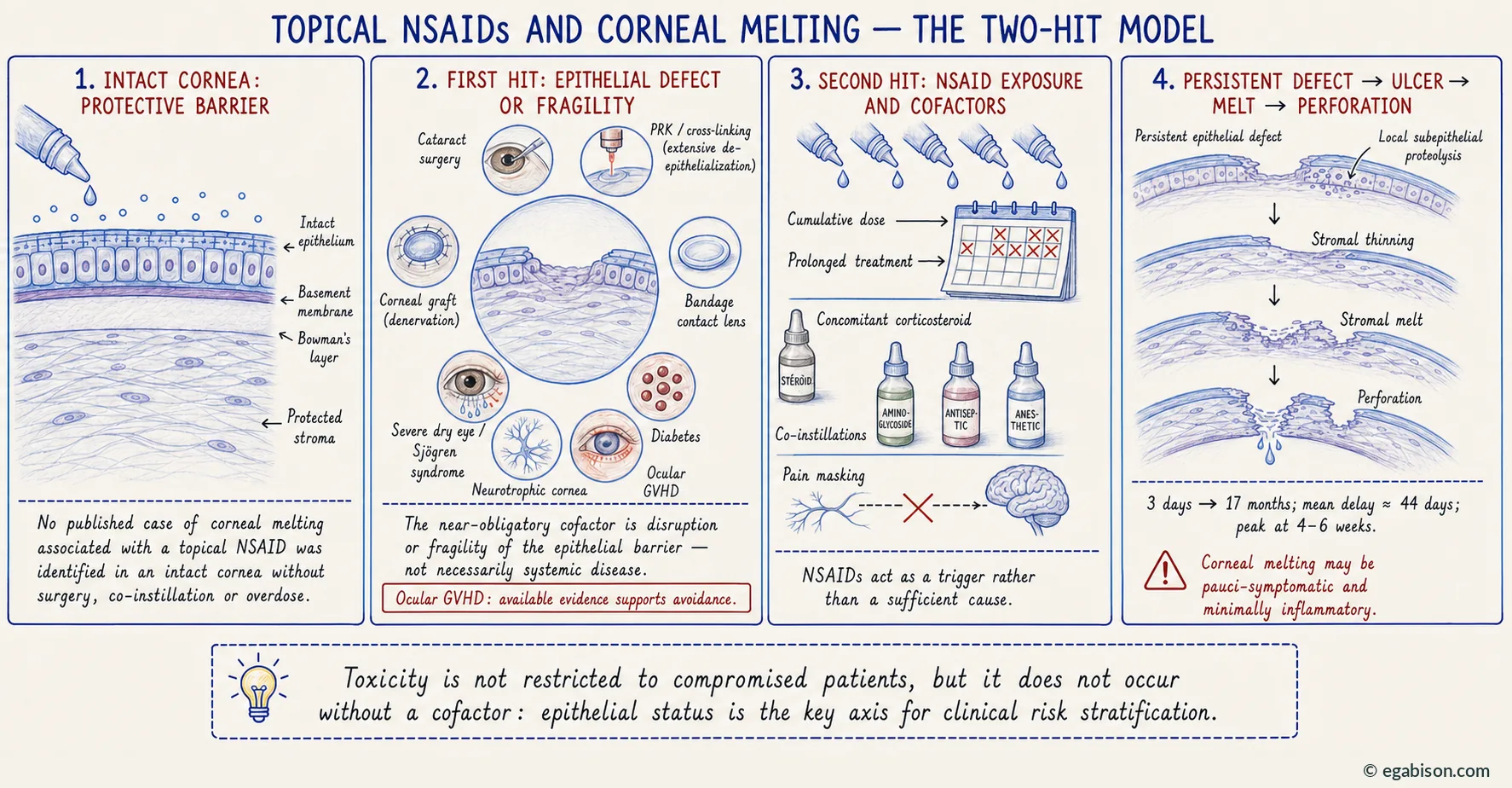
The most rigorous formulation is therefore twofold. Corneal toxicity of topical NSAIDs is not confined to debilitated patients: it can occur without pre-existing systemic or ocular surface disease. But it does not occur in the absence of any cofactor: no published case of keratolysis on an intact cornea, without surgery, without co-medication and without overdosing, has been found. Epithelial breach or fragility is the near-obligatory cofactor.
The decisive question is not "does this patient have Sjögren's, GVHD, neurotrophic keratopathy?". It is "is the epithelium of this eye intact, and will it stay so throughout the prescription?". The first question remains useful. It only indicates how likely the answer to the second is to change along the way.
The 1998-1999 US outbreak
In August 1998, Falcon Pharmaceuticals — Alcon's generics subsidiary — launched a diclofenac sodium 0.1% ophthalmic solution on the US market. From January 1999, surgeons reported unexplained keratolysis. The first MedWatch report naming ophthalmic diclofenac dates from 31 March 1999. The ASCRS alerted its members on 3 August. The product was withdrawn that autumn. The originator Voltaren Ophthalmic stayed on the market.
Precise pharmacovigilance figures for this episode circulate in the secondary literature. As they could not be retrieved from the primary FAERS database, they are not reproduced here. Three facts are solidly established. Reports cluster over roughly thirteen months. A single product is massively over-represented: 53.8% of cases in Congdon[Congdon 2001], 7 of 11 in Flach[Flach 2001], 2 of 27 versus 0 of 1,500 in Hargrave[Hargrave 2002]. And severe corneal events decline clearly after its withdrawal.
The most discriminating observation in the entire series is that of Hargrave et al. at the Zale Lipshy University Laser Center[Hargrave 2002]: 1,500 patients undergoing PRK on ciprofloxacin + rimexolone + suprofen — no adverse events. The next 27 patients received the same protocol with suprofen replaced by Falcon diclofenac 0.1% — two acute keratolyses, both perforated. Only one protocol parameter differed. This is the strongest published argument for product imputability; it says nothing in itself about which constituent was responsible.
The landmark series
| Series | Size | Molecules | Latency | Main message |
|---|---|---|---|---|
| Flach 2001 Trans Am Ophthalmol Soc |
11 patients | Falcon generic diclofenac 7, Voltaren 4 | 6 d – 17 months | "Inconsistent and variable" dose-toxicity relationships → multifactorial aetiology. All cases had coexisting disease or treatments. |
| Guidera 2001 Ophthalmology |
16 patients 18 eyes |
Generic diclofenac 9, Voltaren 1, both 1, ketorolac 3, preservative-free ketorolac 1 | 4 d – 15 months (15/16 < 3.5 months) |
2 severe keratitis, 3 ulcerations, 6 corneoscleral melts (50-80% depth), 5 perforations grafted. 11/16 post-cataract, ≥10/16 on concomitant corticosteroid. |
| Congdon 2001 J Cataract Refract Surg |
129 patients 140 eyes |
NSAID identified in 81.8%; generic diclofenac 53.8% | — | Severity: 36.4% mild, 39.3% moderate, 24.3% severe. Under the generic, serious events occurred at lower doses and in less compromised patients. |
| Cabourne 2020 J Cataract Refract Surg |
13 patients | Ketorolac + neomycin/polymyxin/dexamethasone | — | Routine cataract surgery, unselected corneas: 5 melts, 1 perforation with endophthalmitis, 8/13 at ≤ 6/36[Cabourne 2020]. |
The signal by molecule
There is no direct head-to-head comparison between molecules with a reliable denominator. What the literature does allow:
- Diclofenac — the most incriminated molecule, overwhelmingly because of the Falcon formulation. But also under the US originator, under European formulations (France[Mortemousque 2002], Italy[Zanini 2006], Turkey), in preservative-free form, and under the generic reformulated without tocophersolan[Johnson 2011].
- Ketorolac — cases in Guidera (including bilateral perforations after 4 days of preservative-free ketorolac in a patient with undiagnosed Sjögren's), Congdon, post-PRK, post-conductive keratoplasty, post-vitrectomy, and the Cabourne series.
- Bromfenac — three landmark Japanese cases (including a perforation on day 5)[Asai 2006], one in Stevens-Johnson syndrome, one after combined cataract + pterygium surgery, one perforation in undiagnosed Sjögren's. These Japanese cases are decisive: the formulation contains no tocophersolan.
- Nepafenac — a clear signal despite late marketing: Bekendam 2007, Wolf 2007, Di Pascuale 2008, Feiz 2009 (bilateral post-PRK melt in a 35-year-old with no risk factors)[Feiz 2009], Mohamed-Noriega 2016 (post-crosslinking in a diabetic keratoconus patient)[Mohamed-Noriega 2016].
- Indomethacin — perforation after 3 weeks in a long-standing rheumatoid arthritis patient; marketed in France but not in the United States, which explains its absence from American series.
- Flurbiprofen — no melt series identified; implicated instead in post-PRK subepithelial infiltrates. A comparative study of more than 4,500 eyes cited by the ASCRS found no melt.
- Pranoprofen — no case found; absence of publication is not absence of risk, as the Japanese and Chinese literature was not exhaustively searched.
The ASCRS position is unambiguous: "every topical NSAID has been implicated in severe corneal events"[ASCRS]. This is a class effect, modulated by formulation and dose — not an accident specific to one molecule or manufacturer.
Surgical contexts
Cataract surgery
The dominant context (11/16 in Guidera, the majority in Congdon). The recurrent aggravating factor is prolongation of treatment beyond the usual window for chronic cystoid macular oedema. The ASCRS recommends 4 to 6 weeks after uncomplicated phacoemulsification, up to 12 weeks in patients at high risk of CMO — that is, precisely diabetics and complex surgery, the population at risk of melt. The paradox is explicit and unresolved.
Photorefractive keratectomy (PRK)
The best-documented context after cataract surgery, and the one in which the "cleanest" cases have been published. Cofactors are present by construction: extensive epithelial defect, bandage contact lens holding active drug and preservative against the surface, intraoperative topical anaesthetics, denervation by photoablation. LASIK, by contrast, has produced no case of NSAID-attributed melt — consistent with the absence of an extensive epithelial wound and much briefer exposure.
Crosslinking
The context of maximal risk: wide de-epithelialisation, thin cornea, bandage lens, repeated anaesthetic instillation. Published cases are catalogued in Moramarco's review[Moramarco 2024].
Corneal transplantation
Persistent epithelial defect under diclofenac was described as early as 1995[Shimazaki 1995]. The graft combines complete denervation, unstable epithelium, prolonged corticosteroid therapy and frequently dry eye: every identified cofactor. No specific imputability series exists, but the recommendation to avoid NSAIDs is consistent.
Vitreoretinal and pterygium surgery
Toxic keratolysis under combined ketorolac + prednisolone after vitrectomy; two cases under bromfenac after pterygium surgery. Not to be confused with surgically induced necrotising scleritis, which is linked to mitomycin C and beta-irradiation.
Incidence: the methodological void
No adequately powered prospective study exists, and Rigas et al. explicitly conclude that the incidence remains unknown[Rigas 2020]. Available benchmarks are heterogeneous:
- A retrospective review of 501 records (167 bromfenac, 167 ketorolac, 167 nepafenac; mean duration 26 months) found no melt and proposed an extrapolated incidence of 0.00172%. Caveat: publisher of contested quality, and the extrapolated figure contradicts national pharmacovigilance data by an order of magnitude.
- Medsafe New Zealand, March 2023: no suggestive case reported to CARM, for more than 11,000 patients exposed per year[Medsafe 2023].
- The highest incidence ever reported, 7.5%, is considered by Rigas as probably overestimated.
- Consensus time frame: onset from 3 days to 17 months; mean latency ≈ 44 days, peak at 4-6 weeks.
No FAERS or EudraVigilance disproportionality study devoted to ophthalmic NSAIDs and keratolysis has been published, despite the availability of the databases and the maturity of the methods. This is a feasible, low-cost piece of work that would settle the question of a differential signal between molecules and finally allow a reporting rate per unit sold to be estimated.
Recent systematic reviews do not fill this void. They are not powered for it. The 2022 Cochrane review of NSAIDs in cystoid macular oedema reports that most trials observed no difference in ocular adverse events, corneal toxicity included[Cochrane 2022]. That is the expected result for so rare an event. It therefore cannot be read as reassuring.
The 2015-2026 period has produced only isolated cases: no series comparable in size to Guidera or Congdon, no quantitative reassessment since 2002. Since 2006 the signal has shifted towards bromfenac and nepafenac, and towards non-cataract contexts: crosslinking, surface surgery, vitrectomy, pterygium — in fragile eyes.