
The tocophersolan hypothesis: why it fails
For twenty-five years the secondary literature has attributed the American outbreak to an excipient — tocophersolan, the vitamin E solubiliser of the incriminated generic. That hypothesis is now refuted twice over: by formulation and by the topography of MMP induction. This chapter retraces the reasoning step by step, because the error is instructive and continues to be cited.
The 1999-2002 reasoning
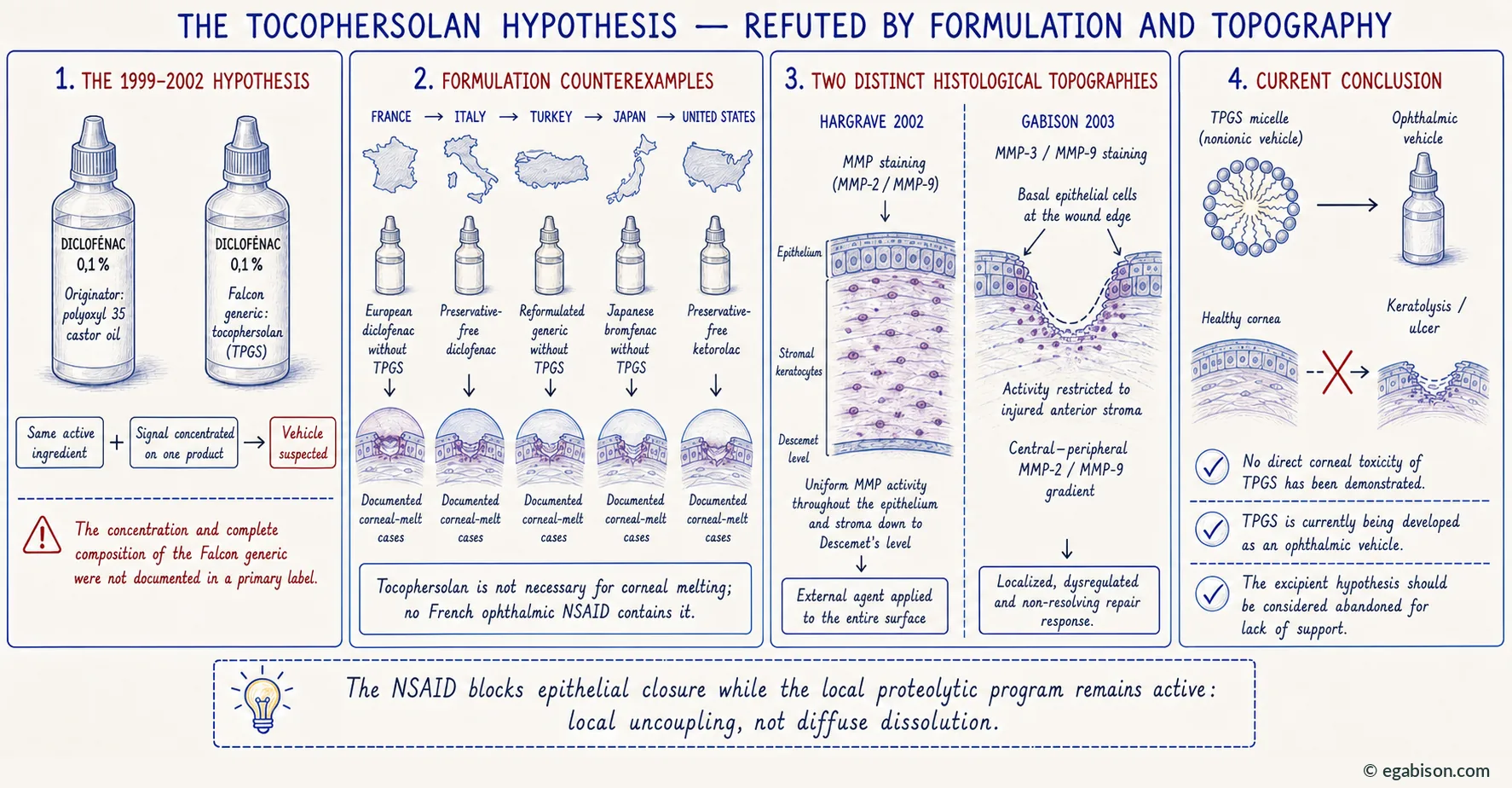
The argument was well built. The active ingredient was identical in both products: diclofenac sodium 0.1%. The signal was concentrated on one of them, and it disappeared when that product was withdrawn. The difference therefore had to lie in the vehicle. The Falcon generic used tocophersolan (d-α-tocopheryl polyethylene glycol 1000 succinate, TPGS) as solubiliser, where the originator used polyoxyethylated castor oil.
The biological support invoked was that TPGS "inhibits epithelial cell proliferation and induces apoptosis". Tracing this back to source, the support is thin: it rests on work concerning retinal pigment epithelium and tocopheryl succinate — not TPGS and not cornea. Sakamoto et al. showed inhibition of proliferation and migration of bovine RPE cells without loss of viability — and those authors saw this as a potential therapeutic benefit. Extrapolation to human corneal epithelium has never been experimentally validated.
The title of Hargrave 2002 carries the hypothesis ("Possible role of the vitamin E solubilizer…"), but the body of the paper never names tocophersolan in its results. Its conclusions are: uniform, non-reparative distribution of MMP expression, "suggesting the involvement of some outside agent". It is the title, more than the results, that the subsequent literature took up.
In Hargrave, therefore, the excipient hypothesis rests on no chemical or toxicological datum: it rests entirely on a topographic argument. If MMP expression reflected a repair response, it would be localised to the injured site; since it is diffuse, it reflects an agent applied to the whole surface. The strength of the hypothesis thus depends on the validity of that premise — and it is the premise that the refutation addresses.
Compared formulations
United States, 1998-1999
| Voltaren Ophthalmic 0.1% (originator) | Falcon generic 0.1% | |
|---|---|---|
| Solubiliser | Polyoxyl 35 castor oil | Tocophersolan (vitamin E TPGS) |
| Preservative | Sorbic acid 2 mg/mL | not documented |
| Chelator | Disodium edetate 1 mg/mL | not documented |
| Buffer | Boric acid, tromethamine | not documented |
No primary label for the Falcon product could be retrieved. Only tocophersolan is named, and only in the secondary literature; its concentration is unknown. This column must not be completed by inference: no verifiable source attributes benzalkonium chloride, Solutol HS15 or octoxynol 40 to this product.
France and Europe, current formulations
| Product | Notable excipients | BAK | Tocophersolan |
|---|---|---|---|
| Voltarenophta 0.1% unit dose | Polyoxyethylated castor oil, trometamol, boric acid | no | no |
| Voltarenophtabak 1 mg/mL | Macrogolglycerol ricinoleate, trometamol, boric acid (ABAK filter) | no | no |
| Indocollyre 0.1% | Arginine, hydroxypropylbetadex; thiomersal in multidose | no | no |
| Acular 0.5% | Octoxynol 40, disodium edetate | yes (0.01%) | no |
| Nevanac 1 and 3 mg/mL | Tyloxapol or guar gum/carmellose, carbomer | yes (0.005%) | no |
| Yellox 0.9 mg/mL | Tyloxapol, povidone, sodium sulfite, borax | yes (0.005%) | no |
| Ocufen 0.12 mg | Polyvinyl alcohol, citrate | no | no |
No French NSAID eye drop contains tocophersolan, and no diclofenac eye drop — French or American — contains benzalkonium chloride.
The facts that refute the hypothesis
If tocophersolan were necessary, no keratolysis should occur under a formulation that does not contain it. Yet:
| Observation | Formulation | Significance |
|---|---|---|
| Gabison et al. 2003, France[Gabison 2003] | French diclofenac — polyoxyethylated castor oil, no tocophersolan | Late perforation after PRK under prolonged diclofenac (> 2 months) in a diabetic patient stable for 10 years, negative autoimmune workup. Stromal accumulation of transitional collagens III and IV, MMP-3 and MMP-9 in the injured anterior stroma, MMP-9 in basal epithelial cells at the healing front. A double refutation: melt without the incriminated excipient, and topographically restricted proteolytic induction. |
| Mortemousque 2002, Bordeaux[Mortemousque 2002] | French diclofenac | Two ulcers including one grafted perforation; button histology showed total destruction of corneal innervation, bringing the picture close to neuroparalytic keratopathy. |
| Zanini 2006, Italy[Zanini 2006] | Voltaren Ofta preservative-free | Keratolysis on day 5 after LASEK. First case under preservative-free diclofenac — eliminating both preservative and tocophersolan simultaneously. |
| Johnson 2011, United States[Johnson 2011] | US generic reformulated | Central corneal melt under the very formulation from which tocophersolan had been removed. |
| Asai 2006, Japan[Asai 2006] | Japanese bromfenac | Three melts including a perforation on day 5, with no tocophersolan in the formulation. |
| Guidera 2001, patient 14[Guidera 2001] | Preservative-free ketorolac | Bilateral central perforations after 4 days, undiagnosed Sjögren's. Neither preservative nor tocophersolan, and minimal duration. |
The topographic argument
Refutation by formulation is refutation by counter-example: it establishes that the excipient is not necessary, but leaves open the possibility that it also acted in the United States. Refutation by MMP topography is of a different nature: it addresses the reasoning itself.
| Hargrave 2002 | Gabison 2003 | |
|---|---|---|
| MMP distribution | Uniform — epithelium, stromal keratocytes and the level of Descemet's membrane | Localised — injured anterior stroma and basal epithelial cells at the healing front, i.e. the subepithelial zone of the ulcer |
| Gradient | Not reported; homogeneity is the headline result | Documented central/peripheral differential for MMP-2 and MMP-9 activity and expression |
| Authors' inference | "not consistent with the localization expected of a repair response, suggesting the involvement of some outside agent" → an agent applied to the whole surface, hence the vehicle | Profile consistent with a localised repair response, but dysregulated and non-resolving → delayed epithelial closure and lysis at the ulcer |
Induction restricted to the subepithelial zone of the ulcer, with a central-to-peripheral gradient, is exactly the signature of a healing response — the very pattern Hargrave argued should have been observed had no outside agent been involved. The drop bathes the surface uniformly: were it acting as an applied toxin, induction should show the same uniformity, which is not observed. The topographic premise on which the excipient hypothesis rests is thus contradicted by observation, in a case where the excipient was moreover absent.
The NSAID does not create ectopic proteolysis. It blocks epithelial closure — through loss of 12-HHT and BLT2 signalling — while the local proteolytic programme remains active. Lysis therefore outpaces repair. Not because a diffuse toxin dissolves the cornea, but because repair is arrested at the ulcer while degradation continues. This is local uncoupling, not diffuse injury.
TPGS today: a vehicle, not a toxin
No study, in vitro or in vivo, demonstrates corneal toxicity of TPGS. On the contrary, it is now used as an ophthalmic vehicle: a permeation promoter for riboflavin-5'-phosphate in crosslinking, a micellar formulation improving the bioavailability of chlorhexidine, CoQ10-TPGS drops in neuroprotection. A review is devoted to it under the title "attributes beyond excipient".
The other solubiliser fares no worse. Polyoxyethylated castor oil, the originator's — hence the excipient deemed "innocent" in 1999 — has been formally assessed: non-irritant and non-cytotoxic up to 0.25% in NRU, HET-CAM and BCOP models. Neither is a corneal toxin.
A genuinely toxic excipient does exist. Benzalkonium chloride arrests cytokinesis from 0.01%. It disrupts the epithelial barrier from 0.005%. It induces apoptosis and oxidative stress, and exerts indirect neurotoxicity on trigeminal neurons.
The comparison clarifies two things. First, this is what excipient toxicity data look like when they exist — and nothing comparable exists for TPGS. Second, it does not apply here: no diclofenac eye drop contains BAK.
The American signal: three readings
Refuting the excipient does not exempt one from explaining the epidemiological signal, which is real. Three readings remain compatible with the data, none of which can be taken as established:
- A vehicle-related threshold effect. The active ingredient would be the cause, a vehicle constituent lowering the dose and susceptibility threshold. This is what Congdon suggests. But no candidate has ever been identified.
- An exposure artefact. The generic was cheaper and widely substituted in routine postoperative prophylaxis — hence prescribed to a broader, less selected population. A difference in denominator, not in product, would produce exactly the same over-representation.
- A reporting bias. The signal was built by an ASCRS call for cases issued after the generic had been designated, in a climate of professional distrust of generic substitution.
Established — NSAID keratolysis is a class phenomenon, linked to inhibition of the COX pathway, blockade of epithelial closure and local MMP dysregulation, requiring an already compromised cornea. It occurs with every molecule, in every country, with or without tocophersolan, with or without preservative.
Not established — that the vehicle plays any role whatsoever. The excipient hypothesis survived twenty-five years on the strength of an article title and a topographic inference that observation contradicts. It should be regarded as abandoned for want of support — not demoted to the rank of minor cofactor, which would leave it a credit the data do not give it.