
EMMPRIN/CD147
EMMPRIN/CD147, mediator of direct interactions
A glycoprotein discovered in cancer biology
EMMPRIN (Extracellular Matrix Metalloproteinase Inducer), also known as CD147 or basigin, is a transmembrane glycoprotein of the immunoglobulin superfamily, carrying two extracellular Ig domains. It was identified in the 1990s in cancer biology, on the surface of tumor cells of epithelial origin, where it is responsible for inducing MMPs in neighboring stromal cells through direct tumor–stroma contact [2]. Beyond MMP-1, -2 and -3, EMMPRIN also increases expression of the plasminogen activator system (uPA) and its receptor, with no effect on their physiological inhibitors (TIMP-1, TIMP-2) — thereby multiplying the target cell's proteolytic potential without restraining its natural control [2].
From healthy to ulcerated cornea
In the healthy cornea, immunohistochemistry localizes EMMPRIN mainly in the epithelium, concentrated in basal cells, and barely detectable in the unwounded stroma. In ulcerated corneas, in contrast, EMMPRIN is markedly induced in the subepithelial stroma and precisely co-localized with MMP-2 at the epithelial–stromal interface — a co-localization also found in isolated fibroblasts in culture, where EMMPRIN and MMP-2 concentrate in the same membrane microdomains [2].
The proof of direct contact
Epithelium-fibroblast co-culture system
To establish the causal role of cell contact, a co-culture system brought corneal epithelial cells and stromal fibroblasts into direct contact, forming a clear interface between the two cell types. Double-labeled confocal immunohistochemistry revealed strong staining of EMMPRIN and MMP-2, restricted to fibroblasts bordering the interface with the epithelium — exactly the pattern observed in ulcerated corneas [2]. To rule out any influence of secreted cytokines, fibroblasts were then incubated with purified membranes from epithelial cells, rich in EMMPRIN: these alone were sufficient to induce MMP-1, MMP-2 and EMMPRIN expression by the fibroblasts themselves — an effect abolished by a blocking anti-EMMPRIN antibody, demonstrating the direct causal role of this glycoprotein [2].
The self-amplification loop
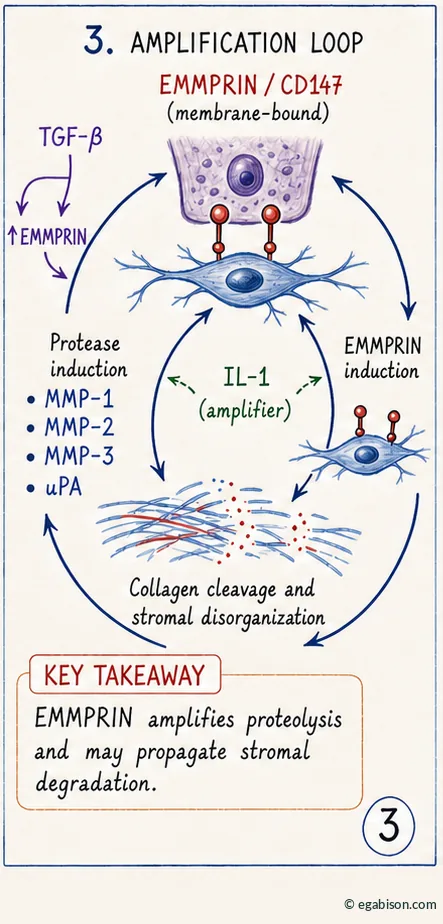
EMMPRIN has the property of inducing its own expression through a positive feedback mechanism — already documented in cancer biology. It is furthermore itself upregulated by TGF-β and IL-1 in corneal fibroblasts. The result, once direct contact is established, is a self-sustaining loop: cytokines released during injury increase EMMPRIN in both the epithelium and the fibroblasts, direct contact further amplifies this level in fibroblasts, and the resulting EMMPRIN overexpression propagates MMP induction deeper into the stroma as new fibroblasts are recruited to the contact zone [2,4].
EMMPRIN amplifies proteolysis through a two-stage loop: induction of MMPs/uPA on one hand, self-induction of its own expression on the other. This mechanism is what allows matrix degradation to spread beyond the initial contact point, rather than staying localized.
Glossary of abbreviations used in this course
Scientific acronyms and abbreviations used across the 3 pages of this course, listed alphabetically.
No matching term.
- AMT
- Amniotic Membrane Transplantation
- α-SMA
- alpha-smooth muscle actin, myofibroblast marker
- cDNA
- complementary DNA, used in transfection to overexpress a protein
- CD147
- cluster of differentiation 147; synonym of EMMPRIN and basigin
- ECM
- extracellular matrix
- EGF
- Epidermal Growth Factor
- EMMPRIN
- Extracellular Matrix Metalloproteinase Inducer; synonym of CD147
- FAK
- Focal Adhesion Kinase
- direct-ESI
- direct epithelial–stromal interactions
- Ig
- immunoglobulin domain, extracellular structural motif of EMMPRIN
- IL-1
- interleukin-1
- KC
- keratoconus
- LASEK
- Laser-Assisted Sub-Epithelial Keratomileusis
- LASIK
- Laser-Assisted In Situ Keratomileusis
- MMP
- Matrix Metalloproteinase
- PDGF
- Platelet-Derived Growth Factor
- PED
- persistent epithelial defect
- PRK
- photorefractive keratectomy (surface laser photoablation)
- siRNA
- small interfering RNA
- Smad
- effector proteins of the TGF-β signaling pathway
- TGF-β
- Transforming Growth Factor beta
- TIMP
- Tissue Inhibitor of Metalloproteinases
- uPA
- urokinase-type Plasminogen Activator